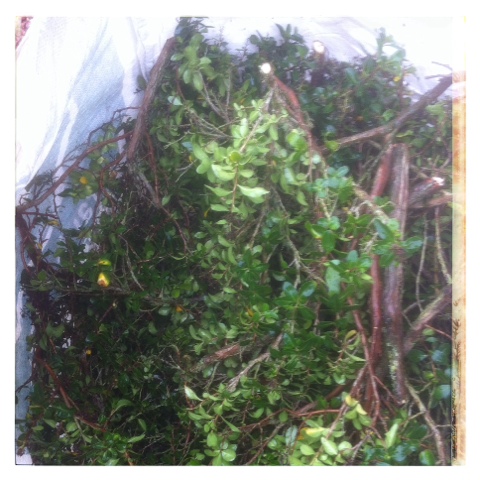
Showing posts with label Pruning. Show all posts

Sunday, 14 February 2016

Border control

Recent storms have seriously worried our tired East fence. Hubby's made some emergency repairs but they're only stop gaps. It needs replacing. Strengthening one's borders is just so on trend in Europe this Winter... *rollseyes*

We'll be delegating the carpentry to our mate. He's not due for a little while, which buys us time to clear away the shrubbery. This is double edged though, as we suspect the mature vegetation is now an integral, structural component of our shabby larch lap boundary.
 
There've been some hasty repairs during the Winter storms

A sword of power

The other year I bought Excalibur - a monster of a hedge trimmer. Time to wield it once more.

We've got 30m to clear so this is no time for subtlety. That goal has helped nip in the bud the usual dithering - no point in spending the whole day finessing the first metre; GET ON WITH IT!

We started with the biggest job - the North East border by the side of the drive. Even if we don't get the full length of the fence cleared, making a dent in this overgrown mass will be a significant step.
 
Before & After
Woohoo! What a difference. Some shape to that border looks great :) The fence, however.... :/

Discoveries

As we hacked through the thicket/border, some interesting things came to light. Now I think about it, I'm sure the TV gardeners have said that pruning is a great opportunity to check the general health & well being of your plants...
 

Disease

Bracket fungus on the broken bottle brush branch
In the depths of the bottle brush thingy there was a lot of dead wood. Not only dead but mushroomy. Looks like a large branch has broken near the base, & some time ago too. All of that has to come out, in case the fungus stresses the living bits.

New plants

Surprise! More plants!
Initially I thought "Wow, up to the yellow conifer all ready!" But when I stepped back, I realised I had unearthed a similar, separate, shorter conifer. Right. Just what this place needs...

Hard against the fence there was something else, but completely different. A clump of arrow straight, bright mid green stems. No idea what it is - it's bambooesque, but the leaves are wrong. I've cut it back to the ground & we'll see if it regenerates.

Litter

On the house side of the big yellow conifer I found the only litter stash of the day. I'm amazed there wasn't more. I used to find all sorts of treasure in the old hedge... but then that was a border with public land, so I've clearly not thought this through. Anyhoo...
 
Roof tiles, succulents &...

...a duck's head. Obvs.


Given the rather random mix of items, my best guess is they were dumped as the previous owners were clearing out... Who knows...

Team work & fitness

I can plan, but I'm also prone to getting caught up in the moment. If I've been putting a job off for a while, when I finally commit to doing it I tend to charge in headlong. But my energy is not boundless. When out walking, Hubby & I use a "percentage knackered" scale - if we're getting toward 50% knackered, it's time to head back. We had to instigate this cos I can be more stubborn than my body is able to cope with. Mind over matter is great in theory, but when the matter conks out, it takes the idiot mind down with it...

So, I would've done this job alone, bagging up the trimmings as I went. But hurrah! Hubby mucked in & tidied as I hacked.
1st load of several
And a bag of kindling for the fire

With the two of us on the case, we got the bulk of it done - all the way up the drive to the house.
There's a few bits left - at the side of the house & then by the South Lawn, but these will be a doddle as the borders are smaller & the plants less massive.

How heavy is heavy?

When I bought Excalibur, the reviews were divided: "Too heavy!" said a few. "Absolute pish" others replied. Of course, how heavy something feels to you depends on how strong you are & how long you're holding the damn thing for...

Excalibur is quite heavy for me, but has been fine as long as I take regular breaks to let my arms recover. During one such break in this job I realised my left hand was losing the ability to grip my drink - a sign of my forearm muscles getting a caning I think. Excalibur is a 2-handed sword, so my left arm was getting way more exercise than it's used to.

By the time we'd bagged up the last of the day's trimmings, I was proper goosed; a good 70% knackered. Fortunately the sofa wasn't very far away, so I adjourned there... for the rest of the weekend. Come Monday I was still pretty achy, & then on Tuesday my right groin gave out down the skate park - definitely not a place to be nursing flaky muscles.

Rather than attack jobs like the Tazmanian Devil, I wonder if I can get into the habit of 'little & often'...? Probably not.

A few weeks later...

Panels? What panels?
Another storm came in. Yep, those plants definitely were protecting the fence from the worst of the weather. Oops.
Ah well, less demolition required when the fencing folk arrive.

Update

New fence is in!
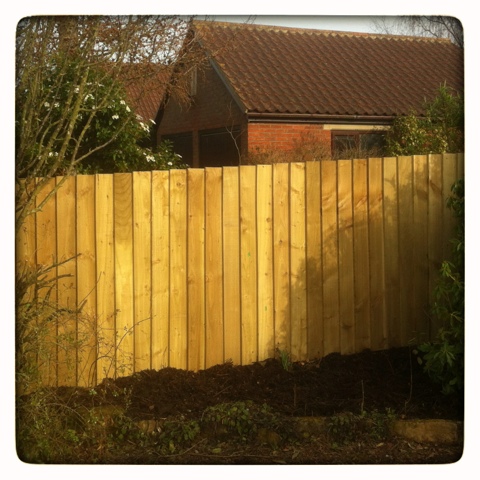
Looking golden in the evening sun
The fencers were super speedy & the new boundary was up in 2 days. Rather than panels between the posts, we've gone for individual boards, so we can smoothly follow the curves of the slopes.

Hedgehog hole all part of the service.
Much better, & the neighbours are happy too.

Sunday, 24 January 2016

3 part hack - part 1

Radio silence

Not a lot of writing last year, but not a lot of gardening either. Sometimes life clubs you round the head & you have to take time out.

Some folk find gardening helps when they're low. Not me, unfortunately. I tend to hermit myself away to get better. Sadly, neglecting the garden becomes just something else to get anxious about. However, I know I'm coming out the other side when I find myself pulling on my boots & grabbing the secateurs...
 

Pruning

It strikes fear into the heart of the dabbling gardener. The nemesis of many. The TV experts smugly smile as they assure & reassure us that pruning is easy; nothing to worry about. But that's why I started this blog - I've a 50:50 success rate with things like pruning. It seems no matter what I read before I cut, I always find out, when it dies, I had the exception (I'm looking at you, Hebes...)

But I try to be brave. After all, if we don't prune here, our garden will become part of the woods & the lawns will be reclaimed by brambles.
 

Reigning in the brutes

In the mature garden that came with this house, many shrubs have romped. With each one there's the task to identify what it is & then decide what we want to do with its shape.

Typically, the plant most in need of a haircut remains an enigma - still no idea what it is. But it overhangs the drive & gets bashed by delivery vans.

Pruning issues unpicked

Unpicking what I've read about pruning over the years, I suspect the reason the advice seems so complex is the experts are addressing several issues at once, without telling us they're doing that. From what I can see, it breaks down like this:
  1. Will I kill it?
    1. Will it regrow from old wood?
    2. If I prune it at this time of the year, will it be more vulnerable to disease/attack/weather?
  2. Will pruning lead to a better plant?
    More fruit, more flowers, more manageable/attractive shape.
  3. Will it look bad this year?
    Losing this year's flowers/fruit.
I've ordered these from Crisis to Is That Even A Thing. When you're unsure what you're doing, the key issue is the 1st one - the others are just laughable whimsical luxuries; potentially so ludicrously expert considerations they're not even on the radar.

Most of my pruning still focuses on Question 1.

Will I kill it? Old wood or green wood

This is the big one. The plant can probably recover from any other pruning mistake.

Some plants you can scalp back to the ground & they'll happily throw out new shoots from the base. Anyone who has tried to prune a privet to death, & failed, has experienced this.

However, some plants can only produce new shoots on green wood - this or last year's growth. Cutting too far into the old wood is how I've killed at least 2 Thymes. I've also seen plenty of conifer hedges trimmed back into the old wood that never green up again.

If you don't know what's right for your plant, definitely look it up. If you can't find the info, err on the side of caution.

Will I kill it? Making it vulnerable

Dormant
For most things, the advice is to do major pruning when the plant is dormant, which usually means in Winter.

If you hack at it in the Summer, when the plant is in the middle of its big number, it risks throwing its sap everywhere & not having enough leaves to feed itself. This probably won't kill it, but it'll put it under a lot of stress, which can be the shoo in that attacking insects & fungi are waiting for.

Frost damage
Pruning in Winter can leave the plant more at risk from Jack Frost nipping at the cut ends. However, this isn't usually a death sentence. The damage tends to only be 1 node's worth - it'll just mean it'll re-sprout a little further back from where you pruned. Besides, the plant is used to a bit of Winter battering - that's why it does the dormancy thang in the first place.

Disease/attack
Just like us, when a plant gets a cut, that cut can get infected. If the sap is flowing, it can be party time for insects such as aphids. Also, if there's fungal spores around the cut, there's a risk that the sap will take them into & around the rest of the plant. These risks are minimised when you prune a dormant plant.

Summer trims
All of which makes it sound like you should only prune in Winter, but that's not strictly true either. It's often fine to do small trims in the Summer - you can see the final shape better when the leaves are on. Plus, dead heading is a pruning job & that can encourage the plant to produce more flowers for longer. Just leave the big hacks 'til the plant has had its Winter general anaesthetic.

Tell me I'm wrong

So if you're more expert than me (not hard), & you're reading this thinking "Well, that's wrong, & that's total horse", please let me know & I'll correct it.

An experiment

So, given all that, I'm at step 1 with the leggy shrubby drive-side thing - trying not to kill it. Last year I tried a light test prune: if I chop it back into the old wood, will it regrow from just behind the cut?

The result: a bit meh. It put on new growth (yay!) but it was a bit pathetic (boo).

We'll have to take this gently then.
 

Working with what we've got

Hacking it right back I suspect will just kill it. But leaving it fairly big is not all bad - the leaves are now mostly about head height, revealing some interesting branches below.
Interesting stems

I've heard about 'lifting the crown', often used to give a more architectural shape to trees & big shrubs, so I think I'll try that.
 

A prune in 3 parts

For less vigorous plants, I've read that pruning in 3s is less traumatic for the plant - take out a third in the 1st year, another third the next year, & the final third in year 3.

This is my plan.
 

Before & after

Apologies for poor pics. My vision's starting to change, so it's getting hard to tell if I've taken a decent photo :/ plus I'm impatient...
A little off the top
Thinning out the sides
It really doesn't look like much does it? But the clippings filled the dumpy bag* to over half way.

* The huge sack you get when order sand or gravel in bulk.
 
I did prune, honest

Doing the heavy lifting

Off to the tip with trimmings, & I was a little nervous. Last time I went, the staff just about barged me out of the way to tip the clippings into the skip. I fucking hate that. It may take me a little more time (a whole minute), but I will do it myself, & if I need help I will ask. What strength I have will evaporate if others do the all heavy lifting for me. It's a fine line between politeness, micro-aggression & overt sexism.

Fortunately this time they didn't spot me til I was all done :)

Saturday, 28 June 2014

Over the hedge

Giz a job

Last Sunday. The whole day in. Yay! But which job to tackle? I could stay indoors & sugar soap the walls of the hall loo... Nah, let's get outside!

But which outdoor job? Both lawns were buzzed during the week so I get to pick something else - double yay!

Weeding one of the beds would be good, but I still don't know what half the stuff is. Plus the thought makes my heart sink as there's soooo much to do.
The previous owner, Mrs |H, clearly had maintenance fatigue too...
 

How do I re-home saplings?

I could do a round of sapling eviction. Living on the edge of a wood it's no great surprise that it wants to claim our garden for itself. We have lots of vigorous youngsters that will totally dominate if they stay. I'd really like to donate them cos it seems a shame to trash them, but I've not found anyone willing to take them. Any ideas?

Go with your gut

Finally I use the decision-making technique we've adopted since moving - fix whatever's pissing you off the most. & casting an eye over the South Lawn, it's the overgrown hedge from next door. Don't get me wrong - the neighbours have done a fab job of keeping the level to about half a meter above the fence, but the hedge now overhangs on our side, & this house had been empty for a while before we moved in, so it's got a bit big...
The South East corner needs a haircut
 
It's so dark in that corner, Hubby thinks it's hampering the health of the Cherry tree that's down there. This member of the jury remains unconvinced about that theory but it'd be cool to neaten up that bit of the hedge. So let's have at it & test the Cherry theory - we can do science, us!

Getting cracking

First cut, along the fence line.
 
I kept a close line along the top of the fence.
 
Some of the panels have fallen in a bit, another sign of how unruly the hedge is getting, so we didn't think the folks next door would have any problem with this wrangling plan, but just to keep things friendly, we felt we needed a chat before tackling the biggest bit. However, the neighbours were out so I kept going with non-contentious bits.

As I pruned back, I discovered 2 shrubs. Unlike the lovely soft beech hedging, both of these were spiky spiny buggers. One was a large hawthorn, & its thorns were absolutely viscous. Time to get the welding gloves out.
Ouch! These guys take no prisoners.
 

Opps... we've found more garden...

Cutting it all back reveals a whole new corner of garden... I'm now wondering how wise this pruning plan was, cos the garden is already big enough!

I could hear Hubby talking, & twigged he had caught the returning neighbours. They gave the big trim their approval, so we started on the last bit.

The off-cut mountain grows...
 

Biggest last

The best point to cut the last big stem was over their side of the fence. With the neighbours' blessing in place, Hubby tied a rope above the cut, then I got busy with the saw.
I'm feeling the urge to stick googly eyes onto this pic...
 
As the branch started to fall, Hubby gave me the heads up. I ducked out of the way & he pulled it to safety. Like a well-oiled machine... ;)

Now we've just got the clear up to do...

Clear up operation

I hate the word 'just'. It's rarely true, & in my gardening experience, the clearing up always takes much longer than the job itself. I often try to clear up as I go, but those good intentions often evaporate once I'm stuck into the job.
There's a wheelbarrow under there somewhere...
 
We needed a strategy to process the huge pile of trimmings, so we set up a 4 pile system:
  1. Composting leaves & twigs into the dumpy bag.
  2. Firewood twigs into the round black bin.
  3. Chunkier firewood into a pile.
  4. Aggressive stuff (brambles, thorny things) into the garden waste wheelie bin.
Off-cut processing production line
 

Take a break

Half way through the heap & we're getting tired. The sun's come out, my head is starting to bake, & Hubby's getting blisters from all the snip snip snipping. The compost bin is full, the garden waste wheelie bin is almost full. We have a break while we reconsider our options.
Snax!
 
"How about we fill the dumpy bag and take it to the tip?"
Genius! Half & half seems fair to me. The rest of the trimmings can go onto the municipal compost heap.

Put a bit in, take a bit out

Talking of which, I totally failed to find any peat-free compost this week, but a friend reminded me about council compost. £3 a bag from the tip - bonzer :D We'll see how it is.
Why is it labelled "Soil conditioner", not "Compost"?
Should I be worried?
 

Job done

Stepping back, we start to realise what a big difference today's trim has made.
Before & after
 
  1. We can now see the woods to the East, extending our views out.
  2. This corner is in the South East, so when you stand here & look West across the garden, you'll get the last the evening sun before it snicks behind the house. Prime seating location I reckon, cos I love a garden seat, me.
  3. It gives us a clue what sort of changes we'll get in this garden when we lower the Big Beech Hedge that is our Southern boundary.
That day gets ever closer, but we'll need help with that job...
 

Saturday, 15 June 2013

No Lilac flowers this year, then...

As the whole of Spring packs itself into just a couple of weeks, I'll stick my neck out & say the Lilac is not going to bother flowering this year:

Lots of green, but no lilac

Its compatriot 3 gardens over is in full pomp right now, but there's no flower buds on ours at all.

I suspect this is the result of another dodgy pruning incident :/

I know that Lilac is pretty robust - I've hacked it back pretty hard in the past with no real bother, but I don't ever recall having a no show like this.

But last year I did my usual thing of pruning it when I could be arsed, rather than when it should be done, & I guess sometimes there's a price to pay.

A bit of online digging indeed suggests that Lilac is best pruned immediately after flowering, so I'll keep an eye on the neighbours' blooms & give ours its annual haircut when theirs goes over. Won't be long now, which is handy as all that green is making a bid to dominate Stinky Dog Corner.

Ah well, fingers crossed for next year.

New Lilac on the block


And talking of the future, the white Lilac root cuttings from my mate have made it through the Winter:

Go little cuttings!

Yay! More residents for The White Corner. However, now I've learn about Lilac's bullying ways, the plan is to plant it on the other side of the wall, on the Council land. Not only will this complete the hedge, but it'll return that area to similar form of a few years ago:

When we moved in, The White Corner had 2 Conifers & a Lilac running along the bottom wall. But as they grew bigger & bigger, they started pushing the wall over. So a few years ago, we had a tree surgeon take them down & grind out the stumps. Our mate rebuilt the wall, & I've been slowly replanting the area since.

It was all quite a change for that bed as it's gone from deep shade to full sun, so some long term residents haven't survived all the drama. And we do miss the huge Lilac that was on the end - not only did it screen us from the street, but it always put on such a great Spring show.

Hopefully the new white Lilacs will grow up big & strong, just like the old one, and will have a bit more room to do it in too.

Aquilegias guard our snailbait Strawberries

You can't see them, but there are Strawberries under this sea of blue:

The Strawbs are under there somewhere...


In normal gardens by normal gardeners, Strawberries are planted out in the open, so they can convert maximum sunshine into sugar & yumminess.

Following conventional soft-fruits-together logic, ours are with the Rasps, planted just in front of them. But some Aquilegia were living there first which means the Strawbs are frequently dwarfed.

So the other year, I had a fit of trying to do right by the low lying soft fruits; do things efficiently & by the book, rather than let things slide & forcing the plants fend for themselves as usual.

Let the sunshine in

Once the Aquilegia had finished flowering, I cut them right back to the ground so the Strawbs could have their moment in the sun.

& the result? Were we forced to eat Strawberry ice cream every meal just to get through the mammoth surplus?

Of course not. Total disaster. A snail-wrought devastation of that year's harvest.

So what the smeg went wrong? I'd done the right thing - how could it possibly have gone so badly?

On reflection I think a clue lies in one of my over-used phrases of the moment: "Your mileage may vary". It seems this is the pinch of salt I should take with standard gardening guidance.

How my mileage varies

Part of the reason for this blog is to document the weirdness I've experienced with gardening. I am after all the woman who has failed many attempts to successfully grow Nasturtiums - the plant so allegedly fool proof they're in the kiddies seeds section, next to My First Watering Can & the Ladybird Sand Pit. My gardening success is on par with chance.

But these days I'm beginning to look beyond the glossy photos, gorgeous cinematography & my "shiny! shiny!" plant-lust. I am starting to hear a little more clearly the caveats with which the journos pepper their stories:

...likes acid soil...

yeah, it might help to know where our soil is on the pH scale. I've read that self-testing kits are useless, but do folk really pay to get their soil tested?

The alternative to testing is the "what already grows well?" rule of thumb. We have a happy Rhododendron, we have heathers too, & a history of conifers, so I'm guessing we're on the acid side.

...tolerates partial shade...

so would actually prefer full sun...?

...is fully hardy...

I'm here to tell you that fully hardy for Northumberland is not the same as fully hardy for Kent.

...Bay is not fully hardy in the UK...

Well the one we have, & the one my Aunt has in the Midlands, & the one in the grounds of Moorbank Botanic Garden clearly missed that memo.

The appliance of science

So how does this rambling ranty diversion relate to the beleaguered Strawbs? Good question! Let's apply some science:

How were previous harvests?
Fine.
A bit of snail damage,
but plenty of fruit for us all.
What was different that year?
Pruned the Aquilegias.
Any other changes?
Nope.
Hypothesis?
The leafy bases of the Aquilegias
in some way hid the Strawbs
from the snails.
Is this sounding a bit crazy?
Yep, but what else is there?
Have snails got great vision?
Or is it a scent thing?
Do we need a "Why?" yet/at all?
Spose not. Yet.
Shall we test the hypothesis?
Let's!
Do you talk to yourself like this all the time.
Yes.
What of it?
Weirdo...

Plan becomes action

So last year, I largely left the Aquilegias alone.

Peek-a-boo, I see you...
They flowered, they set seed. I trimmed back the seed stems before their heads burst cos, as pretty as they are, we have plenty. But I left the leaves alone, allowing them to die back at their own pace.

The result?

Good harvest! The pollinators had no problem finding the Strawberry flowers but the snails barely found the fruit, & the fruit didn't seem to need direct sunlight to ripen.

Yay science!

Will the same method work 2 years in a row? Well the 1st fruits are starting to set right now, so we'll know really soon...

Sunday, 20 January 2013

Snow damage

Oh look, it's the obligatory snow post.

A tale of Winters past

When we had big snow the other year, several things in our garden got a bit of a battering. Worst hit were the blueberries in the yard. When the snow slid off the house roof, it landed all over the pots under the kitchen window, & a number of the long, thin, woody blueberry stems snapped under the weight of the onslaught. Bugger.

The blueberries survived their ordeal though. They were long overdue a prune anyway, so I snipped off the damaged stems. No real harm was done, to my relief.

New Year, new snow

This year, the blueberries have been spared, but the big hebe in middle of the garden is looking a bit overloaded.

As with the blueberries, the hebe could've had a bit of a haircut in the Autumn, but I figured I'd do it all in Spring instead. The hebe is a bit of a beast, & when you prune it hard you're left with a lot of tough thin grey stems - not a very pretty sight all though the Wintertime. My reasoning was:
Prune it in the New Year, then it will put on new growth almost immediately & so be ugly for much less time.

See, not just my usual procrastination & crapness - there's some genuine thought & logic going on here for a change.

But, the hebe has now caught an awful lot of snow. It was quite windy after the biggest blizzard of the week, & that was enough to knock the settled snow off most things... but like the rest of us, the hebe has hung on to its hat.

The hebe's snowy toupee
S'pose I'd best leave the warm snug comfort of the sofa & leap to the rescue, then...

What's the damage?

Once out there I can see that the base of the hebe's snow cap is now ice - not good. Extra weighty, & extra pointy too. Fortunately the ice hasn't trapped any of the stems - everything's sitting on top, which is great as it comes off the plant quickly in fairly big chunks. & that's fab cos like a muppet I've come out without my gloves on & my hands are now FREEZING!

Bit of a hole top right, but nothing broken
 
With the snow off, I can inspect for damage. The hebe's quite a bendy soul, & whilst it's now a little out of shape up on the top, there don't appear to be any breakages. & if that hole up in the top right of the picture doesn't close up as the plant rebounds, the Spring haircut will sort it right out.

Now bugger this for a game of soldiers, I'm off back indoors!

Sunday, 28 October 2012

Hedge scalping 2: Send for reinforcements!

Back in September, I wrote about tackling the annual hedge trimathon. In part 1, I was steeling myself for the job ahead. Now in part 2, I'll take you though this year's change of strategy.

Every year I gripe about trimming the hedge cos it's such a chew on. But this year I decided it was time to garden smarter: I wheeled out the big guns.

Toys!

There are a lot of hedge trimmers on the market, but I have some key needs that quickly narrow the field:

1. Must be electric

Yeah, I've read it all about you get more oomph from petrol & electric trimmers are wimps. But we already have a petrol power tool in our arsenal, a strimmer, & I just can't start the fucker. All that priming, choke tickling, chord ripping nonsense, in this day & age?! Motorbikes have had starter motors for over 50 years ffs. No excuse for it. Get your act together, 2 stroke engineers!!!!

& relax...

moving on...

2. Must chop large sticks

The laurel is such a beast that strong green new growth can already be over 10mm diameter by mid summer. What a monster.

So I needed something with big sharp teeth AND the power to use them.

Final decision hung on power delivery...

3. Batteries v cable?

I was very tempted by batteries - Monty Don has extolled the virtues of the rechargeable batteries route, & I can see that having no trailing cable is handy when your garden covers half of Hampshire.

But on the flipside, I had read a number of reviews saying that whilst the batteries do fine in year 1, performance seriously drops of in years 2 & 3. New batteries every year or so? Doesn't sound very eco to me.

So, as our garden is small enough for every extremity to be in easy reach of a cable, cable it is. I'm pretty sure I can manage not to chop through it or trip over it. Pretty sure...

And the winner is...

Ladies & Gentleman, may I present to you, the Bosch AHS 7000 Pro-T.
Nope, no idea what AHS nor T stand for. Probably nowt...

Awww yeah. Check out that bad boy :)

5 stars on Amazon, plus loads of reviews confirming it's ability to mangle even the toughest customers. Some concerns about weight, but some others saying it's not really a bother...

A swift visit to B&Q & it's mine, all MINE!

Just imagine... I could be this happy when trimming the hedge...

Is that a light breeze or did the hedge just tremble? Mwhahahaha!

Sunday, 16 September 2012

Hedge scalping 1: Know thine enemy

We meet again, my old adversary...

An 8m long wall of privet & cherry laurel runs along the South West wall of the garden. It's great for privacy, for both us & the nesting birds who love it so much. But left to its own devices it would blot out the sun.
Like this, only so thick you can't see through it... (pic from www.springreachnursery.co.uk)

The hedge was big when we moved in & as it's on the bit of land the Council mow, we thought they'd clip it. We thunk wrong, & it grew & it grew & it grew... until it reached the gutters. It was time to take drastic action.

My hubby is a little phobic of the snips, convinced that pruning = killing. & with good reason - we've had a few disasters & near misses is the past ("oh, that rose is meant to be that tall...") But I was pretty confident the privet & laurel would bounce back after a haircut. I mean, I've seen some pretty brutal hatchet jobs inflicted on privet, but I've never seen a dead one.

As ever, my pruning schedule is entirely driven by when I can be arsed. That said, the hedge gets special considerations cos of its residents:
  1. Have all the birds flown?
    Some of 'em raise two broods each year so it pays to let it slide a bit.
  2. Is it too waspy?
    This isn't for their safety but for mine: atop a step ladder, with shears, feyly, frantically, wafting at jaspers...? yeah, I don't want to become just another ROSPA stat.
Cherry Laurel in flower (pic from www.sciencephoto.com)

I try to get the hedge done before the laurel's berries have ripened. I've wussed out a couple of years in the past & my punishment is laurel seedlings in other parts of the garden. Great. More invasive brutes. Just what I need.

In previous years I've done the big hedge hack completely by hand, with shears, loppers & saw. This too is why the job is mammoth: it takes two days of exhausting chopping, followed by several more to gather, dismember & dispose of the offcuts. I thought gardening was meant to be about genteel pottering; this is more akin to the ethnic cleansing of Rhododendrons off the face of Snowdon.

So the hedge stands there, glowering. If I do any other garden job when its trim is overdue, I get a nagging, guilty feeling... cos I should be cutting the hedge.

It mocks me.

Time, I think, for a new strategy...

(to be continued...)

Wednesday, 29 August 2012

Readers' issues: Gooseberry carnage

Well I didn't expect this... Whilst doing my 1st teensy weensy bit of pimping of this blog, I got a question! I feel like I'm on Radio4!

Good evening caller, you're on the air:
"Do you have any tips on how to stop the little b***8rd caterpillars eating my gooseberry bush? I’m thinking a can or petrol and a match might do the job, but have consequences..."

Oh! Oh! I think I know this one!

We had the exact same problem a few years ago & I remember Carol Klein covering this on Gardeners World. I think she said they were sawfly larvae &, this might sound weird, they don’t like a breeze.

Sawfly: scourge of the gooseberry (pic from rhs.org.uk)

The answer is to prune the bush into an open ‘bowl’ shape by removing the stems in the middle. As well as helping the air get in, this has other advantages:

  • It gets plenty of light into the middle of the bush, so hopefully more/better fruit.

  • It reduces the number of prickly branches that are crossing each other & so stops them chewing each other to bits. This means healthier stems which means a healthier plant, so again, hopefully more/better fruit.

A bit of Internet digging shows Gardeners World covered this again, June this year, in Jobs for the weekend, so here it is from the horse's mouth:
"Sawfly can strip redcurrants, whitecurrants and gooseberries of all their leaves in a matter of days. And a good way to deter them is to keep the centre of the bush clear of new shoots. This discourages the adults from laying their eggs, and the green, caterpillar-like larvae from hatching out and munching their way through the plant."

Anyhoo, I hope this option is as successful for you as it has been for us. Let me know how you get on.

Happy pruning :D

Monday, 27 August 2012

Wrangling raspberries

Monty was tidying his raspberry canes on this week's Gardeners World. Timely, I thought, I've been avoiding doing that job for at least 3 weeks...

Out with the old, in with the new

Raspberries, pre-chop

This year's berries are long gone, as we're usually picking around Wimbledon time, & those fruiting stems are properly dying back now. By contrast, this year's new stems are tall, vigorous & bright bright green. Deffo time to sort them out.

Despite their prickly exterior, raspberry plants are surprising brittle - they snap as soon as you look at them & they don't repair themselves. To survive the blusters of Winter & make it through safely to provide lots of fruit next year, they need our support now.

But 1st things 1st: the old brown stems won't fruit again next year so they are all snipped out at the base. So I don't damage the new stems, I remove these offcuts very carefully, often snipping along the length of the old stem & removing in shorter sections - it's a bit safer.

A bit of structure

Cos they're tall & our garden is small, the raspberries are planted against a wall. This is great for a few reasons:
  • All the fruit is easy to reach by only trampling on 1 set of under-planting.
  • My flimsy bamboo supports can be tied to something much more sturdy.
It's worked so far, but I do rebuild it every year, & have only needed to do the occasional mid-Winter repair after a particularly stormy night.

So last years bamboo comes down - dangerous time as the new stems are well over 6 foot tall & catch the lightest breeze. Thankfully it was a calm day... unlike today which is bloody blustery & from here on the sofa I can see the rasps getting blown all over the shop. Fingers xed it all holds...

New uprights in 1st, then 3 rows - bottom, middle, top, in front of the rasps, so I've trapped the stems between the frame & the wall.

A bit of bondage

Normally I don't bother to tie the stems in any further than that - the wall/frame sandwich being sufficient. Monty was a bit more forceful & recommended tying each stem into the support, to stop them flapping about. To be fair, I have noticed a fair bit of stem damage where their spines have been rubbing up against each other, so hopefully this'll stop that.

Tying in stems

A little off the top?

Something else mentioned on Gardeners World: chopping the very tops of the tallest stems. Normally that's exactly what I'd do too (woohoo! go me!). But earlier this year on a trip to Alnwick Garden, I spotted a different approach.

Looped raspberry canes at Alnwick Gardens

As you can hopefully see in the pic, the Alnwick Gardeners loop over the long raspberry stems & tie them back into the frame. Genius. Extra fruit! My guess this is done now, when the stems are green, cos they will bend a bit if you're careful. So I've tied in the tops of all the stems that are long enough. Some aren't quite there yet, so I'll do those a little later. I'm a bit worried they're a bit skinny tho...

Tying in the tops

All done

A mulch of homemade compost around their feet & that's the rasps done for another year. Hurrah!

Freshly wrangled raspberries